

ISO 9001 vs 27001: Which Fits Your Business?
- Jun 28
- 6 min read
A surprising number of businesses start by asking the wrong question. They ask whether ISO 9001 vs 27001 is the better standard, when the real issue is what problem the business is trying to solve. If you are responding to customer requirements, tightening internal control, preparing for tenders or reducing operational risk, the right answer depends on your priorities, your industry and how mature your current systems already are.
For some organisations, ISO 9001 is the logical first step because it creates structure across the business. For others, ISO 27001 is the immediate priority because information security risk has become a commercial issue, not just an IT concern. The standards are different in purpose, but they are not in competition in the way many people assume.
ISO 9001 vs 27001: the core difference
ISO 9001 is the international standard for quality management. Its focus is on building consistent processes, meeting customer requirements, improving performance and creating a framework for continual improvement. It looks at how the business operates overall, from leadership and planning through to delivery, monitoring and improvement.
ISO 27001 is the international standard for information security management. Its focus is on protecting information through a risk-based management system. That includes confidentiality, integrity and availability of information, supported by controls covering people, processes and technology.
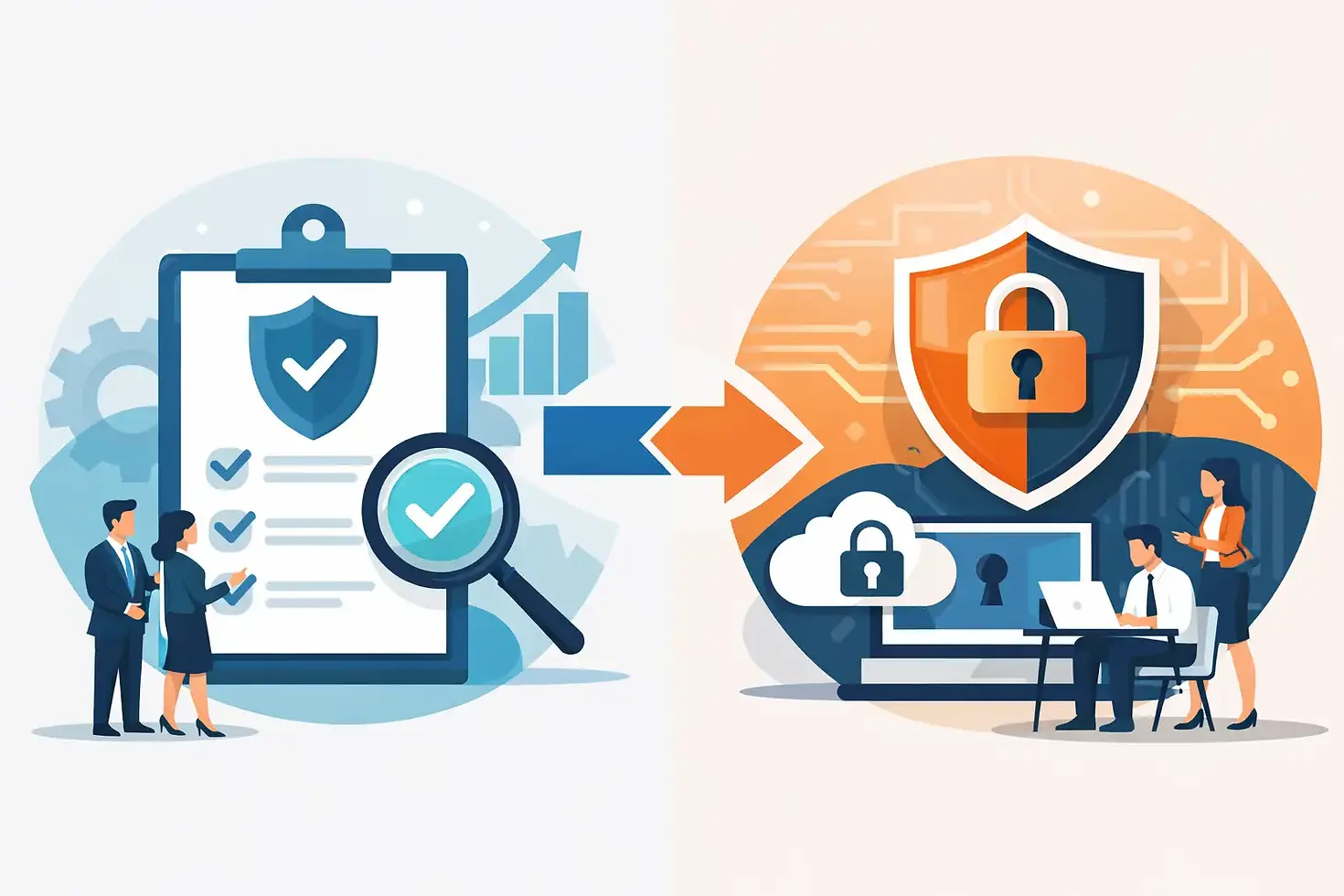
In straightforward terms, ISO 9001 helps you run the business more consistently. ISO 27001 helps you protect the information the business depends on. One is broader in operational scope. The other is deeper in security governance.
That distinction matters because the benefits, implementation effort and evidence expected at audit stage are not the same.
What ISO 9001 is designed to achieve
ISO 9001 is often seen as the most accessible starting point for businesses formalising their management system. That is partly because its principles are familiar. Most business owners already care about customer satisfaction, reducing errors, improving efficiency and making sure responsibilities are clear. ISO 9001 simply turns those goals into a managed, auditable system.
For SMEs, this can be especially valuable where growth has outpaced structure. Teams may be working hard, but processes sit in people’s heads, documentation is inconsistent and outcomes depend too heavily on individual knowledge. ISO 9001 helps create repeatability.
The standard is also commercially useful. In many sectors, it strengthens credibility with customers, supports tender submissions and demonstrates that the business takes quality and control seriously. That does not guarantee better performance on its own, but when implemented properly it gives leadership much better visibility of what is working and what is not.
What ISO 27001 is designed to achieve
ISO 27001 deals with a narrower topic, but for many organisations it is the more urgent one. Clients are increasingly asking suppliers to demonstrate how they protect data. Regulators expect stronger governance. Cyber risk is now a board-level concern, even for smaller businesses.
This is why ISO 27001 has become more relevant well beyond the technology sector. Professional services firms, manufacturers, healthcare providers, outsourced service companies and public sector suppliers may all need to show that sensitive information is properly controlled.
The standard requires organisations to identify information security risks, assess them, decide how they will be treated and implement proportionate controls. That could involve access control, incident management, supplier oversight, staff awareness, asset management, backup arrangements and business continuity measures. It is not just about firewalls and software. In practice, many weaknesses come from poor process discipline, unclear ownership or inconsistent staff behaviour.
Which standard should come first?
This is usually the most practical question, and the answer is not always the same.
If your main challenge is inconsistent delivery, unclear processes, customer complaints, weak accountability or a need to improve overall operational control, ISO 9001 often makes sense first. It establishes management system discipline and creates the foundations for future certifications. Businesses that implement ISO 9001 well are often better prepared for ISO 27001 later because they already understand document control, internal audits, corrective action and management review.
If your main challenge is client pressure around data protection, contractual security requirements, handling sensitive information or reducing cyber-related risk, ISO 27001 may need to come first. This is particularly true where certification is a requirement for winning work or retaining key accounts.
There is also a middle ground. Some businesses pursue both standards as part of an integrated system. That can be an efficient route if the organisation has the leadership commitment, resource and need for both. However, trying to do too much too quickly can create unnecessary pressure, especially in smaller teams where key people already wear several hats.
ISO 9001 vs 27001 for SMEs
For SMEs, the biggest concern is often not the standard itself but the burden of implementation. Many assume ISO certification means heavy paperwork and a system that slows the business down. That can happen if the project is handled badly, but it is not what the standards require.
A well-designed ISO 9001 system should simplify operations, clarify responsibility and reduce avoidable rework. A well-designed ISO 27001 system should give you control over information risk without creating bureaucracy that nobody follows. The challenge is building a management system that reflects how your business actually works.
This is where smaller businesses need to be realistic. ISO 27001 can demand more specialist input, particularly around risk assessment, technical controls and the Statement of Applicability. ISO 9001, while still rigorous, is often easier to embed across the business because its themes are more operationally familiar. That does not mean one is easy and the other is hard. It means the implementation profile is different.
Where the standards overlap
Although their aims differ, ISO 9001 and ISO 27001 share a common management system structure. Both require leadership involvement, risk-based thinking, clear objectives, competence, controlled information, internal audit, corrective action and continual improvement.
That overlap is useful. It means organisations do not need separate systems running in isolation. Policies, audits, reviews and improvement actions can often be aligned. For businesses considering long-term certification strategy, this can reduce duplication and make future expansion more manageable.
It also helps from a cultural perspective. Staff do not need to learn two completely different ways of working. Instead, they can work within one structured framework that addresses different business priorities.
The commercial case behind each standard
ISO 9001 is often chosen because it supports growth. It improves consistency, gives customers confidence and helps businesses present themselves as controlled and credible. It can also expose inefficiencies that are quietly affecting margin, service quality and capacity.
ISO 27001 is often chosen because it protects trust. It can help satisfy procurement requirements, reassure customers and demonstrate a serious approach to information handling. In some sectors, it is quickly moving from a competitive advantage to a baseline expectation.
The trade-off is that the return on investment may look different. ISO 9001 benefits are often seen in process performance and customer outcomes. ISO 27001 benefits are often seen in risk reduction, market access and assurance. Both can create commercial value, but not always in the same way or on the same timescale.
How to decide without overcomplicating it
If you are weighing up ISO 9001 vs 27001, start with three practical questions. What do your customers expect? Where is your business most exposed? What internal weakness is costing you most?
If customer expectations centre on quality, consistency and service reliability, ISO 9001 may be the stronger fit. If expectations centre on data handling, security assurance and supplier controls, ISO 27001 may be more pressing. If both are true, the decision comes down to urgency, resource and whether a phased approach would be more effective.
It is also worth looking honestly at your current maturity. Businesses with informal processes and limited management system discipline often benefit from getting the basics right before adding more complex certification requirements. Others already have structured processes in place and are ready to extend them into information security.
With the right guidance, either route can be practical and proportionate. ParagonQMS supports businesses in turning standards into workable systems, with implementation that strengthens performance rather than creating unnecessary administration.
The best choice is rarely the one that looks most impressive on paper. It is the one that solves the problem in front of you and leaves the business stronger, clearer and better prepared for what comes next.


Comments